Isambard Kingdom Brunel
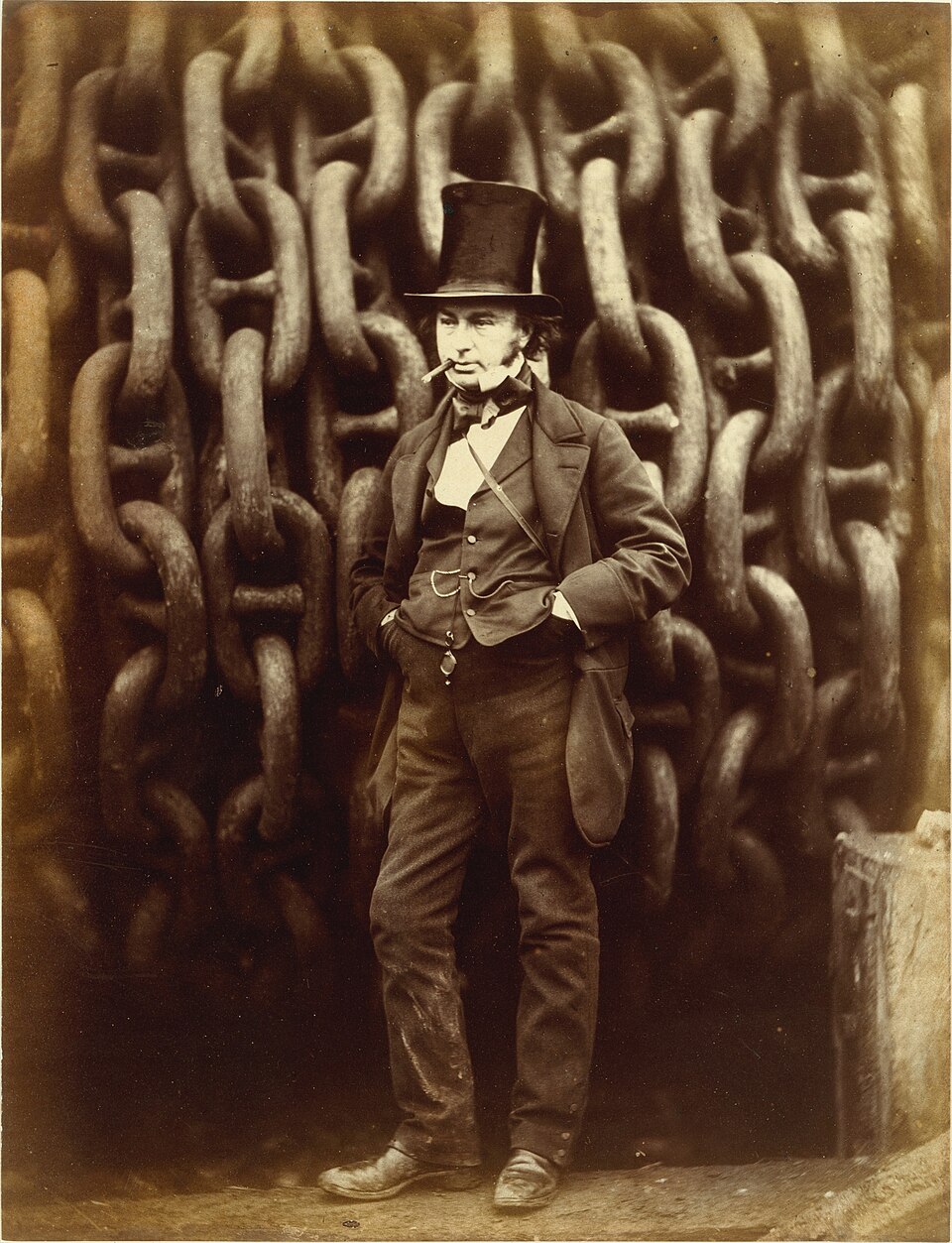
What failed
He was resident engineer on his father's Thames Tunnel when a flood in January 1828 killed six men, seriously injured him and forced him off the job. Thomas Telford rejected every entry in the 1829 competition for a bridge over the Avon Gorge, his among them. He won the rerun in 1831 only after the judges had declared another entrant the winner and he had argued the committee into reversing it; the Bristol Riots stopped the work that year, and by 1843 the towers stood in unfinished stone with the money gone. Great Western Railway shareholders in Liverpool tried to have him removed before the line reached Bristol. A fire in the engine room of the SS Great Western in 1838 dropped him twenty feet. The Gauge of Railways Act 1846 made 4ft 8½in the gauge for new passenger lines, with exceptions that penned new broad-gauge building into the West Country and South Wales. The atmospheric railway in South Devon carried passengers for under a year. The Great Britain went aground at Dundrum Bay in September 1846 and the salvage bankrupted her owners. The Great Eastern ruined the company that built her before she carried anyone.
What happened next
There is no single moment of vindication here, and the record does not offer one. The works that survived ran alongside the ones that did not, in the same years and often on the same accounts. The Great Western Railway opened from London to Bristol on 30 June 1841. The Great Britain was floated out in 1843 as the first ocean-going ship with an iron hull and a screw propeller, and is in Bristol today. In 1855 he designed, built and shipped a prefabricated military hospital to Renkioi in five months. The Royal Albert Bridge at Saltash opened on 2 May 1859; he was too ill to attend the ceremony and was taken across two days later on a wagon. He had a stroke on the deck of the Great Eastern on 5 September 1859 and died on the 15th, aged fifty-three. The Clifton bridge was completed in 1864 by other engineers to a revised design. The Great Eastern was auctioned the same year for £25,000, against a build cost estimated at £500,000, and converted into a cable-laying ship. The broad gauge lasted until May 1892, when the last of it was converted over one weekend.
The point
The failures and the successes were not sequential; they overlapped. In one decade he opened the line to Bristol, floated out the first iron-hulled screw steamer, watched an Act of Parliament pen the gauge into the West Country, and ran an atmospheric railway that lasted under a year. His own institution's obituary called the atmospheric attempt signally unfortunate, and recorded that he paid up every call on his shares in it and refused the fee he was owed. Two of the works he is best known for were settled after he was dead: the Clifton bridge, which other engineers finished, and the Great Eastern, which was sold for a fraction of her cost. What the record shows is a working life in which a large share of what he attempted did not come off, built at the same time as the share that did.
The sequence
13 documented failures, shown with the successes in between. Every entry carries its own source — the wins are part of the record, and leaving them out is how these stories get distorted.
- 1828
The Thames Tunnel flooded again on 12 January and six men died.
- 1828
Seriously injured in the flood, he was forced off his father's tunnel.
- 1829
Thomas Telford, judging the competition for a bridge over the Avon Gorge at Clifton, rejected every design submitted and pressed for one of his own.
- 1831
In a second competition with new judges, Davies Gilbert and John Seaward preferred the design of William Hawkes of the Eagle Foundry in Birmingham and placed Brunel second. Brunel met Gilbert in person, altered his design and persuaded the judges to reverse the decision; he was appointed engineer on 16 March 1831, at twenty-four.
- 1831
The Bristol Riots stopped the attempt to build the bridge and damaged commercial confidence in the city.
- 1833
Appointed chief engineer of the Great Western Railway, before the Thames Tunnel he had left was finished.
- 1838
A fire broke out in the engine room of the SS Great Western before she reached Avonmouth; Brunel fell twenty feet, was injured, and had to be put ashore at Canvey Island.
- 1838-1839
With the line costing far more than he had estimated, especially at Box Tunnel, shareholders tried to remove him as engineer before it was finished.
- 1841
Box Tunnel opened on 30 June, completing the Great Western Railway from London to Bristol.
- 1843
The SS Great Britain was floated out at Bristol, the first ocean-going ship with an iron hull and a screw propeller.
- 1843
Work at Clifton stopped with the towers in unfinished stone and the funds exhausted.
- 1846
The Gauge of Railways Act, passed on 18 August, made 4ft 8½in the legal gauge for new passenger railways in Great Britain.
- 1846
The Act did not outlaw the broad gauge, as the story usually has it. It approved several new broad-gauge lines but confined them to the south-west of England and Wales, and it was that isolation that killed the gauge.
- 1846
The SS Great Britain ran aground in Dundrum Bay in Ireland on 22 September after a series of navigational errors by her captain.
- 1847
The ship was refloated in August, but the cost of the salvage bankrupted the Great Western Steamship Company.
- 1847-1848
Atmospheric trains on the South Devon Railway carried passengers from 13 September 1847 until the service was withdrawn on 9 September 1848.
- 1855
He designed, built and shipped a prefabricated military hospital for the War Office in five months; it was erected at Renkioi in the Dardanelles.
- 1858
The Great Eastern was by far the largest ship yet built, designed to carry four thousand passengers around the world without refuelling.
- 1858
She was got into the water on 31 January, after many technical difficulties.
- 1858
Her building and launching costs ruined the Eastern Steam Navigation Company; she lay unfinished for a year before being sold on and renamed.
- 1859
The Royal Albert Bridge at Saltash was opened by Prince Albert on 2 May; Brunel was too ill to be there and was taken across two days later on a wagon.
Sources
- Isambard Kingdom Brunel — American Society of Civil Engineers, Notable Civil Engineers
Brunel's foray into railroads was not without controversy, for his eccentric seven-foot gauge hindered the networking of railroad lines, and his “atmospheric system,” wherein trains drew their power from air pumped into a pipe laid alongside the rails, became an expensive and foolhardy adventure for his investors.
- Who was Isambard Kingdom Brunel? — Royal Museums Greenwich
On the 5th September 1859, Brunel was onboard the SS Great Eastern, one of his most notable creations and the largest ship ever built in its time. As the ship tested its engines before setting sail for New York, Brunel had a stroke on deck. He returned to his home at 18 Duke Street, London where he died on 15 September 1859, aged fifty-three.
- Inside the Thames Tunnel, 1830 — SS Great Britain Trust, Bristol Dockyards collection stories
The tunnel suffered several major floods. During one in 1828, Brunel was seriously injured and forced to leave the project.
- Thames Tunnel (Wikipedia)
Six men died when the tunnel flooded again the following year, on 12 January 1828, just four days after a visit by Don Miguel, soon to become Regent of Portugal.
- Isambard Kingdom Brunel (Wikipedia)
Both Brunel and Telford lost to W Hawks, with Telford not even selected as a finalist; Brunel travelled to Bristol to confront Gilbert over his decision and persuaded him to change the winner.
- Clifton Suspension Bridge (Wikipedia)
The winner was declared to be a design by Smith and Hawkes of the Eagle Foundry in Birmingham. Brunel had a personal meeting with Gilbert and persuaded him to change the decision. The committee then declared Brunel the winner and he was awarded a contract as project engineer.
- Isambard Kingdom Brunel (1806–1859) — Network Rail, Eminent Engineers
The construction was more difficult and expensive than Brunel had estimated, especially due to the immense work needed for Box Tunnel near Bath. Shareholders, particularly in Liverpool, were unhappy with Brunel and tried to remove him from his position before the line was finished.
- 033/034/035 — Royal Albert Bridge, Network Rail Corporate Archive
The Royal Albert Bridge was opened by Prince Albert on 2nd May 1859. Brunel was unable to attend the ceremony due to illness. He was able to see the bridge in its completed state 2 days later when he took a wagon across it.
- Institution of Civil Engineers obituary of I. K. Brunel, 1860 (transcribed by Grace's Guide)
In the attempted adaptation of the atmospheric system of propulsion to the South Devon Railway, he was, however, signally unfortunate, in spite of all the ingenuity displayed; but this failure served to bring into view a most pleasing feature of his character, for while he duly paid up all the calls upon the stake he had in the undertaking, he, at the same time, refused to accept the professional emoluments to which he was entitled.
- Gauge of Railways Act, 18 August 1846 (Railway Regulation (Gauge) Act 1846) — The Railways Archive, Primary legislation collection
This act introduced mandated standard gauges of 4 feet 8½ inches for Britain, and 5 feet 3 inches for Ireland; thus signalling the beginning of the end for Brunel's broad gauge network.
- Railway Regulation (Gauge) Act 1846 (Wikipedia)
The act continued legislative approval of the broad-gauge railways constructed by the Great Western Railway engineer Isambard Kingdom Brunel and endorsed the construction of several new broad-gauge lines, but restricted them to the south-west of England and to Wales.
- SS Great Britain (Wikipedia)
her captain made a series of navigational errors that resulted in her being run hard aground in Dundrum Bay on the northeast coast of Ireland on 22 September.
- Great Western Steamship Co — Grace's Guide to British Industrial History
the Great Britain was re-floated in August. However, the cost of the salvage bankrupted the Great Western Steamship Company.
- SS Great Eastern — Grace's Guide to British Industrial History
The vessel was sold for £25,000 (her build cost has been estimated at £500,000) and converted into a cable-laying ship.
- The GWR broad gauge conversion of May 20th & 21st 1892 — The Broad Gauge Society
The last broad gauge trains ran on Friday 20th May, and all GWR owned broad gauge locomotives and rolling stock were moved back to Swindon. Then following advanced preparations - starting at daybreak - over the weekend of Sat 21st and Sun 22nd May 1892, 177 miles of track between Exeter and Truro (and all branches) were narrowed from 7ft 0¼ins to 4ft 8½ins.
Use the ← and → keys to move between entries.
Related failures
Others in technology & invention, and nearby.

Sir James Dyson
Industrial design
5,127 prototypes. That is one method, run five thousand times.
1 documented failure
King Camp Gillette
Invention and manufacturing
Metallurgists at MIT told him it could not be done. He spent six more years failing at it.
6 documented failures
Garrett Morgan
Invention
He hired a white actor to pose as the inventor, then demonstrated his own breathing hood under an assumed name.
7 documented failures
Les Paul
Music and invention
Gibson called him the kid with the broomstick with the pickups on it.
6 documented failures